Afterimage Visual Illusions
An afterimage or ghost image is an optical illusion that appears in one's vision after the exposure to the original image has ceased (eg. the bright glow after looking into strong light). This persistence of vision allows a rapid series of pictures to portray motion, which is the basis of animation and cinema. A few of famous afterimages include illusions of Jesus, Che Guevara, US flag or Italian flag.
Stare at the four black dots in the center of the image for 30 - 60 seconds. Then quickly close your eyes and look at something bright (like a lamp or a window with sunlight coming through it). You should see a white circle with an image inside it.

Stare at the image for at least 30 seconds and then look at something white to see Che Guevara afterimage.

Stare at the red dot on the girl's nose for 30 seconds. Then look at the ceiling (or any white surface) and blink really quickly a few times. You will be amazed to see colorful girl.

Stare at the image for at least 30 seconds and then look at something white to see Italian flag afterimage.

Stare at the image for at least 30 seconds and then look at something white to see US flag afterimage.

Stare at the red dot in the middle for a few seconds. After the time runs out, you'll see colored town while there is actually only black and white.

Stare at the black dot in the middle for 15 seconds and then you'll see a colored castle. Actually it's only black and white. Click the following link for animation.
color castle illusion
Color Blindness Tests
So called, "Ishihara Color Test" is a commonly used method to determine defect of red-green color vision. You are presented with a few colored plates each containing colored dots. Your task is to identify a pattern (eg. number or letter) made out of the dots.
1st Color Blindness Test - can you see a "12" on this plate?

2nd Color Blindness Test - there is a "26" on this plate.

3rd Color Blindness Test - can you trace a line from one "X" to the other?

4th Color Blindness Test - you should see 58 (upper left), 18 (upper right), E (lower left) and 17 (lower right).

Color Illusions
Same color illusion, also known as Adelson's checker shadow illusion (published by Edward H. Adelson) depicts something hard to believe. Square marked B looks considerably lighter than square B, due to the "shadow" being cast upon it. However, color on both squares is precisely the same shade of grey. If you don't believe, use any eyedropper tool or print/cut the squares to verify that both square A and square B are precisely the same.

All grey rectangles are of equal luminance, although the ones in the dark stripes appear brighter than the ones in the bright stripes. (by M. White)

Believe it or not, but the pieces A/B/C all have the same color. Use any color picker, graphic program or simply cover the remainder with your hand to see for yourself.

Surface color of both A and B parts is identical. Just use a finger to cover the place where both parts meet and you'll see.

Yellow Dog vs Blue Dog - both of them have the same color.

The upper chess set is black and the bottom set is black, right? Wrong. Both sets have absolutely the same color, just the background changed.

When you first look at this, how many colors do you see? Some might say they see 3 or even 4 colors, but there are 2 - red and green! People usually think they see 2 shades of red, but there is only 1. Look closely and you will notice on one side that white boxes surround the red boxes, and on the other side, green boxes do! Due to the placement of these boxes you get the "illusion" of different colors. Since white is not considered to be a color (it is the presence of all colors in scientific terms) we can safely say that there are 2 colors present here! Still don't understand?

Focus on the black dot in the bottom right hand corner and the moving grey stripe will eventually turn blue.

Lilac Chase (also known as Pac-Man illusion) is another example of afterimage complementary color (green as opposite to lilac). Follow the movement of the rotating pink dot with your eyes and the dots will remain only one color, pink. But if you stare at the black + in the center, the moving dot will turn green. (by Jeremy L. Hinton)

Line Illusions
In this café wall illusion the parallel straight horizontal lines appear to be bent. Important is that each "brick" is surrounded by the grey line, so a colour in between the dark and light colour of the "bricks".

Are the lines made out of the blue squares parallel? You bet they are.

Hering Illusions suggests that the horizontal lines are bent, however, the distortion is caused by the background that simulates perspective and thus false depth perception is created. (by Ewald Hering)

Which line is a continuation of the black one - the blue or the red line? If you guess that it's the blue line then you are wrong. Take a paper or a ruler to verify that. Human brain very poorly interpretes the path of diagonals. (by Johann Christian Poggendorff)

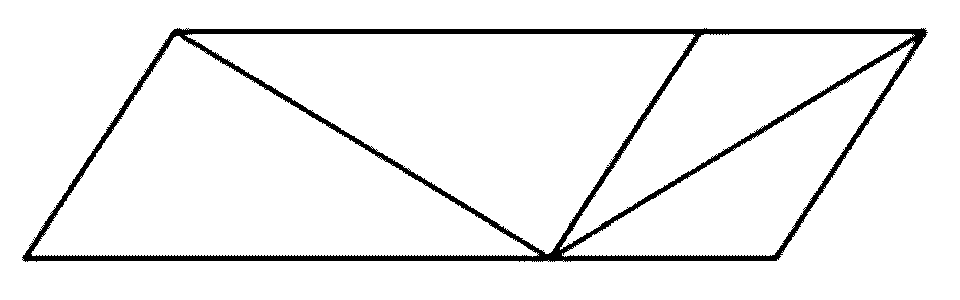
The diagonal line bisecting the larger, left-hand parallelogram appears to be considerably longer than the diagonal line bisecting the smaller, right-hand parallelogram, however, both diagonals are actually the same length. (by Friedrich Sander)

Which line (red or blue) is longer? Of course, none - they are equal.

Are the diagonal lines parallel? Of course, they are - angle of the short lines helps to create the impression that one end of the longer lines is nearer to us than the other end. (by Johann Karl Friedrich Zöllner)

Slanted lines in the following illusions produce a great effect. Both rectangles are parallel - you can take a ruler to check it out.

Do you see some squares or rectangles? Really, this is nothing more than a bunch of lines going in every which direction, but the way our mind interprets these lines are totally different!

A perfect circle.

Sides of a square placed inside a pattern of concentric circles seem curved although they are straight (by Walter Ehrenstein).

3 perfect squares.

There is no spiral on the following picture. It's just nicely put squares that our eyes incorrectly understand as spiral. Look closer.

A nice visual illusion using perfect squares. (© Akiyoshi Kitaoka: Used with permission.)

Perfect squares one more time. (© Akiyoshi Kitaoka: Used with permission.)

All the dice are perfect squares. Switching of black and white color is just tricking us into seeing bent lines although all the lines are straight.

Other Visual Illusions - Perspective and Size
The tabletops are identical in shape and size! I haven't believed that either, until I measured it myself.

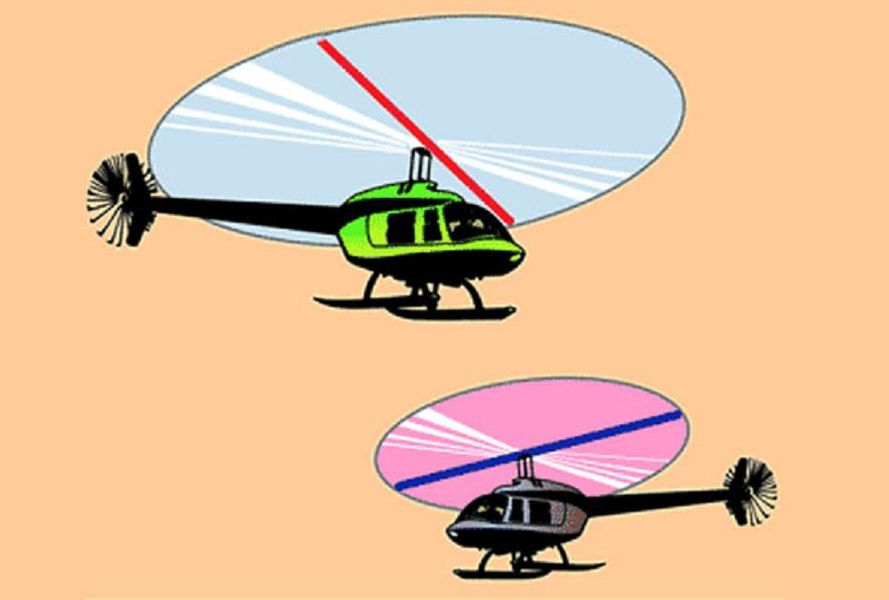
The lower figure appears larger, however, both figures are identical. (by Joseph Jastrow)

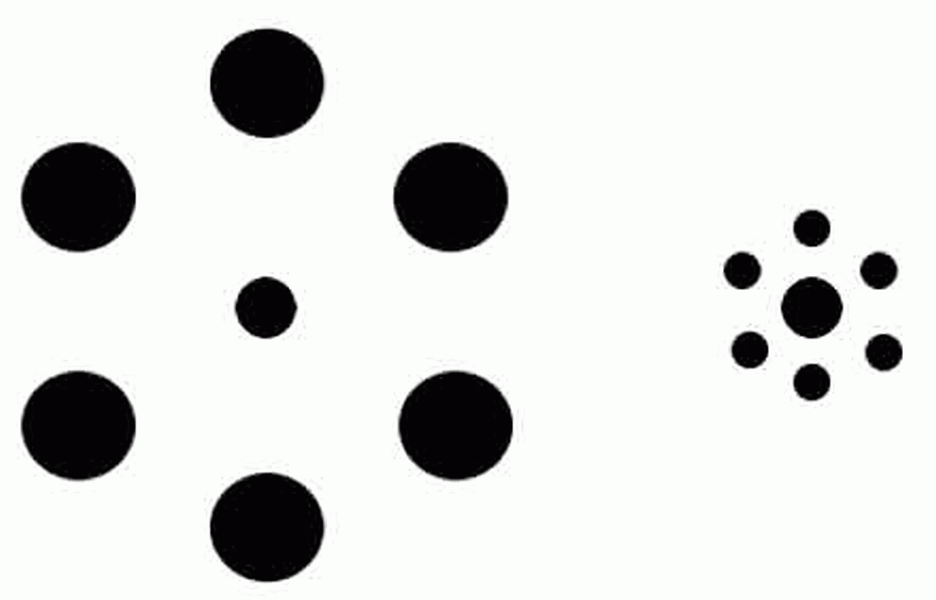
The Ebbinghaus illusion or Titchener circles depicts relative size perception. Which central circle is bigger? The left one or the right one? Are you sure?
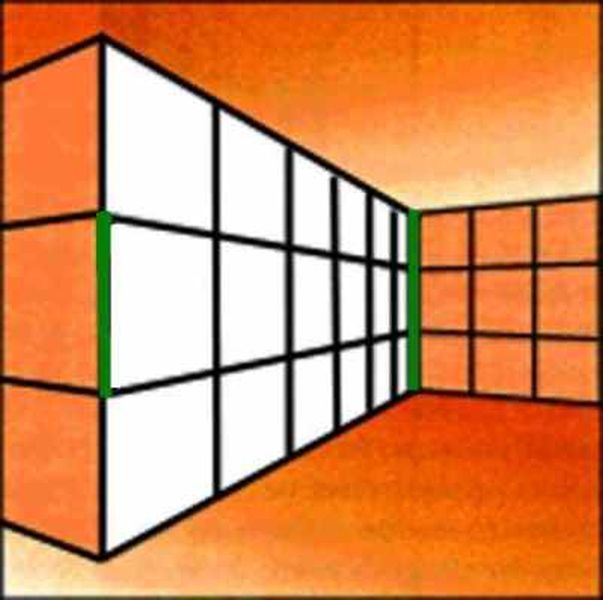
Both green lines have the same length. This Ponzo illusion uses the fact that human brain interpretes the image with perspective, however, it's just a simple 2D image.
Which soldier is taller? This is a variation of Ponzo illusion which suggests that the human mind judges an object's size based on its background.

There are many more illusions on this site. Check out other optical illusions (1st out of 4 illusions pages).